Tuck Everlasting
On Tucker Carlson, political pundits, and a recent biography

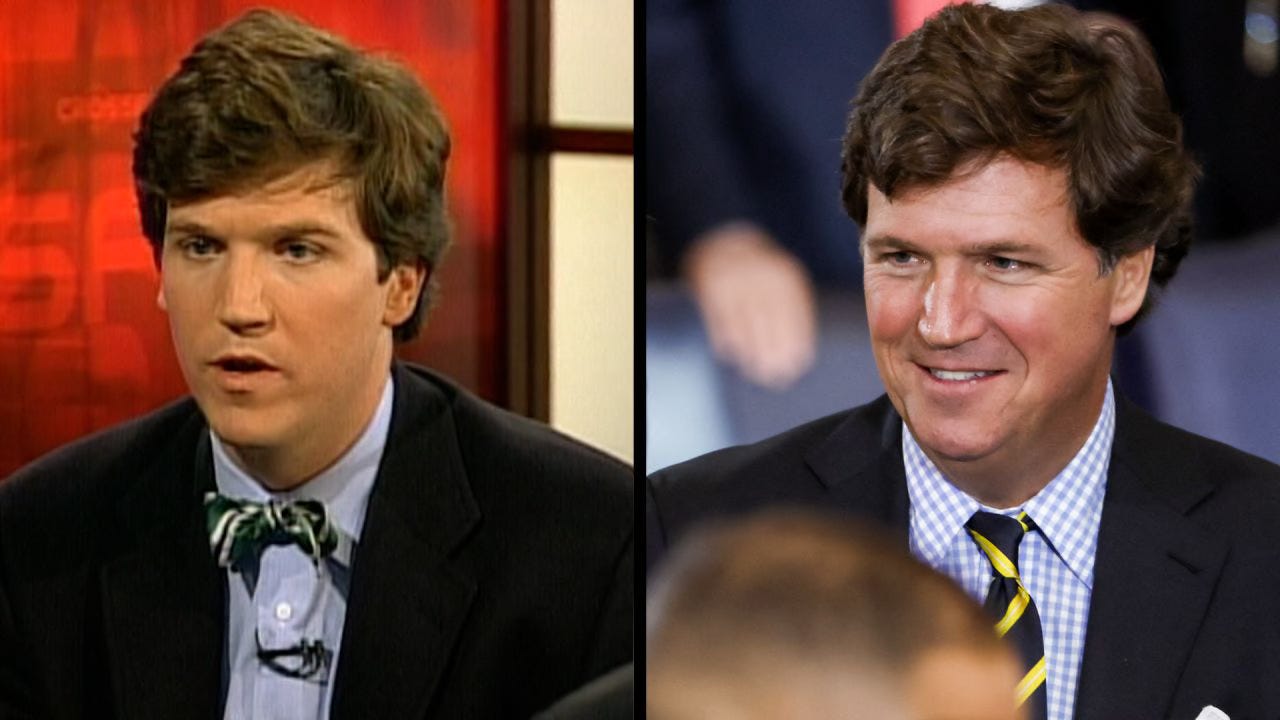
One of the first political reporters I knew by name growing up was NPR’s Mara Liasson. I was fascinated by the way she both reported on and seemed chummy with Republican politicians. But I was also fascinated by the fact she claimed to be a neutral blank slate. Horrible and hopeful things played on the car radio as I zipped around Indianapolis. Later, when Trump was elected and James Comey testified before Congress, I tuned in while working as a delivery driver for Panera, dropping off bread bowls for corporate lunch meetings. Years later, I read Janet Malcolm’s seductive profile of Rachel Maddow for The New Yorker. My curiosity about the power of the pundit was resurrected. The political profile is a precise tool, an exercise in pushing past a subject’s enigmatic restraint or overpowering audacity to say something philosophical—something new.
The age of political punditry has certainly evolved. My Fox-obsessed grandparents grew to enjoy crueler and crueler programming over the years. Hateful rhetoric mirrored the extreme, warped politics of the TV programs and radio shows. Now, the vitriol of early FOX News from 2008 to 2016 seems quaint.
Hated By All The Right People is a new biography of Tucker Carlson written by The New Yorker’s newest staff writer Jason Zengerle. The book tracks the former FOX News pundit’s complicated journey to the top—from his early days as a relatively tame Neocon to his troubled relationship with Trump and ultimately his dangerous flirtation with the President that’s resulted in a wild level of unfettered influence. Zengerle starts his book by noting the outsized influence of the commentator in the MAGA tent. “You can’t work in this White House and not watch Tucker Carlson,” Jared Kushner remarked. But their relationship, as Zengerle notes, was not always so rosy. “[Trump’s] a demonic force, a destroyer. But he’s not going to destroy us. I’ve been thinking about this every day for four years,” Carlson spat out during a rift.
Zengerle writes a surprisingly tender account of Carlson’s rise to prominence. He begins by noting he had a somewhat personal relationship with the conservative thought leader—originally meeting the man when he would come to pick up New Republic writer Stephen Glass for a standing lunch appointment. “Looking back on it now, there was a LARPing quality to all of the political fighting. In print, writers at TNR and The Standard were waging ideological war. In real life, they were meeting for lunch,” Zengerle notes of a sunnier time. Eventually the “sinkhole of social media” would shift journalism’s priorities.
The fulcrum was a 2004 debate with Jon Stewart during Tucker Carlson’s short-lived stint on CNN’s Crossfire. For so long, Carlson had tried to be a voice of reason—someone who cared about facts and accountability. But Stewart destroyed him on air, calling him a “dick” and saying his debate show was “hurting America.” Stewart apparently thought everyone—including Carlson—knew the show was a joke. Apparently not. (A month ago, Stewart doubled down and likened Carlson to Ursula from the Little Mermaid.)
In 2010, Carlson started his own news website and drifted further and further to the extreme right in order to get clicks. His old friends no longer could countenance getting lunch or drinks with who they once saw as a fairly reasonable man. It’s the story of political polarization in America through a single man. “Whether Carlson really believes the awful things that he says these days matters less than that he says them at all,” Zengerle writes.
The Guardian review was critical of the ellipses Zengerle employs: “Zengerle’s smart, well-written, and well-reported book also leaves unanswered three big questions. Unfortunately, these are also the most burning ones: why exactly was Carlson fired from Fox, in 2023, at the peak of his power? Will he run for president? And how earnestly does he hold his increasingly out-there views?” But these are not answerable inquiries. The political profile can unearth secrets, but it can only venture a guess into the hearts and minds of its subjects. If Zengerle humanizes Carlson, he also nails him to the cross, pointing out the man’s kooky hypocrisy with stinging glee.
Carlson’s father, Dick, was also a right-wing talking head. His favorite hobby was outing trans women. In Zackary Drucker’s excellent docuseries, The Lady and the Dale, we meet Dick as he viciously outs Liz Carmichael and tennis player Renée Richards. He instilled macho values to his kid and enjoyed drinking while helming the news. Growing up in California, Tucker hardened his heart against the woo-woo hippies around him. They disgusted him. His father only encouraged such beliefs. Carlson Jr. was not, however, a very disciplined conservative. He never graduated college and barely got into Trinity. For years he felt that he faced the burden of living in an age when “mainstream media… was no country for white men.”
Eventually, he managed to get a second interview at The Weekly Standard and developed a robust freelance career. While it’s nearly impossible to imagine Carlson writing for The New Republic or Slate now, he did. Tina Brown even courted him for Talk, her splashy post-New Yorker magazine. He had a flair for copy and witty repartee when discussing Republican candidates: “Stylistically, a [Rand] Paul speech is about as colorful as a tax return.” The piece ends with Carlson showing up to a Paul rally with two girls from a brothel who joke about using campaign stickers as pasties. It’s the kind of story drinking buddies regale each other with as much as it is a profile of a candidate—his profile of John McCain notes that the candidate prefers a single chilled vodka alone at the end of the night.
Early on, Carlson courted controversy, often by writing controversial polemics about race. He argued that Mumia Abu-Jamal, a Black Panther who murdered a police officer, deserved to be on death row. (Interestingly, Zengerle argues that Carlson’s piece holds up, he critiqued those who believed Abu-Jamal should be judged based on the fact he shot a police man, not on the face he was on Death Row.) He also beefed with conservative personalities, even pouring a Bloody Mary on Grover Norquist. Carlson’s ideology was typical conservative fare: anti-abortion, anti-immigration. But rising to the top of the magazine writing world wasn’t enough. He knew that print was a dying medium. The shining age of Hunter S. Thompson was long-gone. TV was the new gauntlet. Carlson was able to navigate the shifting world of journalism at just the right time—-when FOX and MSNBC were vying for ratings and trying to steal viewers away from CNN. By the end of his cable news career, Carlson had appeared on all three stations—as well as PBS. Punditry had become chic.
At first, Carlson was opposed to the lowest common denominator quality of FOX. “Only masochists would go on [O’Reilly]—-or watch it,” he said in an interview with Newsweek. “I hate to say it because it sounds snobby, but I don’t know anyone who’s read his book.” But by the time Carlson was at the head of Crossfire, he was already being encouraged to drain the nuance from his ideas. He was supposed to be the riled-up Republican, not the “both-sides have a point” guy. Clearly, he took this to heart. Over time he would learn the value of a fight and a put down for ratings. Once he was no longer a magazine writer however, there was no room to give “voice to his doubts.” “Television isn’t conducive to nuance.” The Carlson who now discusses voter fraud and monarchy is a far cry from the man who once recanted his support for the Iraq War and got along well with his liberal colleagues.
When Stewart went on Crossfire, Carlson felt ashamed of the resulting dress-down. The comedian said the show should be a debate, not “theater.” His next venture, a talk show with Rachel Maddow for MSNBC, wasn’t much different—-though he was given a more formidable opponent to square off with than the Crossfire team. Always nimble, when the show failed Carlson dove into reality TV. Of course, it was a dud. Maddow, of course, got her own show, and became the de facto face of MSNBC.
Meanwhile, civility was on its way out. Rush Limbaugh said he hoped Obama would fail. Enter The Daily Caller. What began as an attempt to mimic the New York Times’ desire to get names right soon became an oasis for fringe conspiracy theories. He wanted links from The Drudge Report, something he knew would increase revenue and viewership. “The transformation of The Daily Caller is the Rosetta Stone moment of Carlson’s career, a period during which he learned his lesson. He never sought respectability again, New Republic staffer Alex Shepard wrote in 2021. Isn’t this the tale as old as time? The downfall of fact-checking and clear prose? Journalism’s wary role in defending democracy shifting to tabloid fodder with the political twist of a dirty martini. Carlson’s goal became making liberals mad. But soon Steve Bannon began poaching his far-right, white supremacist writers for his own website, Breitbart, and left Carlson with a dud of a website. The origins of these right-wing “news’ organizations is deeply incestuous and far older than some may expect. Reading the names now feels like digging around Trump’s advisory cabinet picks. Personality politics sell.
This was the “nadir” Carlson found himself at when he was hired to FOX News, the network he’d previously insulted. Once installed, however, he worked his ass off for the conservative cable network. Zengerle anchors a late chapter in the book with an adroit account of FOX News in the lead up to 2016. Just as Trump became a serious operative, Carlson rose through the ranks and eventually booked the now iconic Tucker Carlson Tonight. Here he assumed his rightful role as a telegenic bully. For a brief moment, Carlson was not necessarily pro-Trump, but he was “anti-anti Trump.” The President quickly became a loyal viewer and hung on Carlson’s every word—enthralled by one of the few pundits who did not always bow the knee. Yet the network and Trump enjoyed a cozy relationship: “Where Fox News had long been the Republican Party’s media arm, it now seemed as if the Trump White House was going to become the political arm of Fox News.”
Carlson, for his own part, was wary at first of getting too close to the controversial President. He didn’t enjoy the MAGA leader’s “rococo” style and feared retribution if he partook in any extralegal affairs. Instead, he continued his ritual humiliation of straw men and weak liberals, pushing for more and more extreme guests. (He even tried to bait feminist historian and writer Sophie Lewis to come onto his program.) But as time passed, he realized he could influence Trump’s Cabinet picks, foreign policy, and perhaps even his Covid response. Carlson was one of the few right-wing thinkers to express concern over the virus in 2020, though he would eventually reverse this position.
His disillusion with Trump—or Trumpism without Trump—-didn’t last. While at first he derided the Jan 6 uprisings, he later made a documentary attempting to humanize them and downplay their insurgency. He also worked to behind the scenes to advance J.D. Vance’s Senate run and later his bid for Vice President. Carlson smuggled the work of Curtis Yarvin, Viktor Orbán, Anti-Semitism, and replacement theory into the mainstream and influenced everyone from J.D. Vance to mass murderer Dylann Roof. His version of National Conservatism, or NatCon, was a shift from his original NeoCon positions. “Carlson was no longer just a cable host,” Zengerle writes. “He was a movement leader.”
By the time FOX took him off the air, Carlson was ready to re-ingratiate himself with Trump. Where once he refused to answer the President’s calls, he now relished them, ready to wield his influence without hesitation. “When Carlson had his Fox show, it was relatively easy for him to hold on to America’s attention, but now he was going to need some help. Fortunately for Carlson, Trump needed him too. Their interests aligned most immediately in their mutual desire to stick it to Fox.” When Carlson launched a speaking tour in 2024, Trump and Vance were both special guests at select stops. His interviews with Charlie Kirk, who he called a great Christian, and Nick Fuentes have revealed, however, cracks in the conservative movement. Some have come out against Carlson for his Anti-Semitism. But his power and influence no longer relied on cable news or legacy media. Now, Zengerle wonders, if Carlson might run in 2028 having created his own niche. He wouldn’t be the first media darling to try.
Over the past few months some political reporting books have gained larger mainstream audiences, becoming blockbusters of the genre: Original Sin, Furious Minds, Empire of AI, When the Clock Broke. By tracing the political theater of our past few decades, writers hopes to pull back the curtain on opaque mechanisms. Sometimes, this results in the curious humanization of rather vile positions. At its best, such books use their protagonists to understand larger social weather, the political phenomena that shape our world.
One of the most interesting things of Hated by All the Right People is its insistence on tracing the evolution of journalism and the right-wing Overton window through Carlson. Some on the right flee to anti-Trump podcasts and columns, but Carlson continues to re-invent himself vis-a-vis the President in an attempt to stay relevant—rarely challenging the former Apprentice host. “As he saw it, he’d exchanged one set of comrades for another—and his new set of friends offered him so much more than his old ones,” Zengerle concludes. (The canny ruthlessness of Norman Podhoretz’s Making It, whose son was a colleague of Carlson’s for a time, comes to mind.) Rising to the top of the magazine world is hardly rewarding anymore. Public intellectuals no longer appear on TV.
The distinctive language of pundits and elections is a curious one—perhaps a substitute for the age of French theory and Susan Sontag—where intelligence and technical jargon still hold a modern role in how we live our lives. I’m reminded of Joan Didion’s excellent essay, “Insider Baseball” on election reporting:
“I didn’t realize you were a political junkie,” Marty Kaplan… said when I mentioned that I planned to write about the campaign; the assumption here, that the narrative should be not just written only by its own specialists but also legible only to its own specialists, is why, finally, an American presidential campaign raises questions that go so vertiginously to the heart of the structure.
This is the power of books on “the process,” as Didion christens it. The pundit plays a key role in this transmission of “specialized” language to the people. The problem, of course, is they’re never a natural party, armed with their own preoccupations and sometimes a bald desire for power. Clearly, Carlson has capitalized on the translation of “the process” into not only a ratings coup, but an instrument for far-right ideology. Now that he’s tackled so many of his life-long wishes, it’s only a question of what nefarious goal he’ll dream up next.
Fantastic analysis of how Carlson's transformation mirrors journalism's broader shift from nuance to ratings-driven outrage. The Crossfire moment with Jon Stewart really does feel like a turning piont where he chose the path of least intellectual resistance. I remember when he wrote for New Republic and the contrast with his current positions is almost unrecognizable.