Melanianoma
On the FLOTUS's new movie

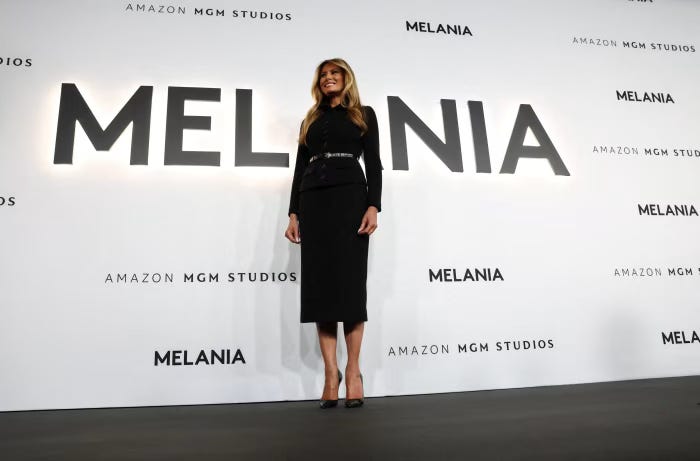
$35 million dollars is a lot to spend on promoting nationalistic propaganda. Aren’t fascists known for cutting sweetheart deals? Melania’s titular documentary, directed by the disgraced Brett Ratner, has already attracted critics’ ire. It’s a big coordinated publicity push for a “film” that amounts to for-profit public relations for the First Lady. For many years, she’s chosen silence. But recently, she’s released a door-stopper of a memoir and now a first-person documentary about the twenty days leading up to the 2025 Presidential Inauguration. Melania is a deeply awkward, uncomfortable, and painful watch that struggles to bridge the gap between the public and private life of the Slovenian-born former model. Of course, it’s funded by Amazon. Jeff Bezos even has a cameo during a massive dinner the night before the Inauguration alongside Elon Musk and other techno-capitalists who cozied up to Trump in the hopes of lucrative tax breaks.
There is somehow far too much and too little to say about Melania. Both the documentary and the person are containers for the empty signifiers she hopes to imbue with some kind of meaning—though with what is unclear. “As a rule, she has existed in the collective imagination not so much as real-life woman, with her own interests and idiosyncrasies, but as a glossy 2-D image, largely known through the mediating scrim of magazine coverage, which has tended to present her as one luxury object among others in her mogul husband’s arsenal,” critic Naomi Fry wrote of the FLOTUS’s memoir in 2024. Fry panned the book, also titled Melania, calling it “is one of the flattest, most abstract, and least revealing accounts of a life that I’ve probably ever read.” Melania’s not above making a statement, but she’s never sure how to land the follow-through. She’s the kind of woman who in 2018 wore a jacket emblazoned with: “I REALLY DON’T CARE DO U?” and then said it was all just a big misunderstanding.
The film features Michael Jackson’s “Billie Jean” an obscene number of times as well as many, many shots of Melania getting in and out of cars and airplanes. (“No sleep, club, another club, bus, plane, wake up” the Lady Gaga refrain echoes.) Predictably, there is also a barrage of drone shots featuring black SUVs winding through Mar-a-Lago. “Home,” as Melania calls it. The extremely high-definition the film is shot in also lends a bizarre, slick feel to the proceedings. There’s no talking heads here—just the smooth, guileless voiceovers of Melania delivering truisms about her life, family, and love for America. The clack of heels becomes the metronome through which we measure time. She only takes them off at the very end of the film, after the Inaugural Ball is over and she can finally eat dinner. A woman’s work is never done.
Allegedly, the film is meant to introduce Melania to the American people. To show us her love for this “great nation.” More often than not, there are only small glimpses of Mrs. Trump’s personality in this film. In the opening montage there’s a bobble head of Trump as a solider. That seems more indicative of Trumpism than Melania’s many bland, beige outfits. It’s not that she doesn’t have taste—it’s just that most of her dresses and outfits are meant to say nothing. “Straight,” she commands her designers. She doesn’t want to ruffle feathers. While her black and white zig-zag dress is admittedly lovely, her Inauguration hat recalls a cartoon witch trying to look professional. While much ado has been made about “Mar-a-lago” face, Melania’s hair, on the other hand, is gorgeous. She is a well-composed, stunning figure even if she doesn’t court modern fashion sensibilities.
Director Brett Ratner has been cancelled. A few times. That clearly didn’t stop Melania from hiring the rapist and sexual predator who moved to Israel in 2023. Pictures of Ratner next to Jeffrey Epstein have also recently surfaced. Throughout the film, the two banter with casual camaraderie. Melania often motions to Ratner to come closer and in turn he asks her about her love of Michael Jackson or encourages her to sing along to “YMCA” during the inaugural festivities.
The film glides along with the soft reassurance of an ASMR video. The problem is Melania, unlike Maria of GentleWhispering, is not a comforting figure. Her ASMR betrays something more grim, a banal and taut narrative about a new day for America. “My creative vision is always clear,” she says. She praises “beautiful shades of griege,” calling to mind the lyrics of Taylor Swift’s Tortured Poets Society album. The film gleefully plays an instrumental of “Everybody Wants to Rule the World.” This is America First on steroids. Imperialism is smooth. There’s no room for messiness in Melania’s world. She arranges her schedule and delivers a film that feels like a resume rather than a vulnerable biography.
Melania’s many homes are sealed shut with palatial gold doors. She orders gold eggs with caviar. “Her colors,” throughout the film, include: white and gold, black and white, navy, and brown. She changes outfits for nearly every shot. Everyone describes working with her as an honor and provides cover for her husband’s immigration policies and anti-LGBTQ Executive Orders. In Melania, minorities provide moral cover. It’s a gauche, macabre horror filmed with the paranoia of a spy thriller. Melania continually voices her fear for her family’s safety. After all, this is only months after the attempted assassination in Butler, Pennsylvania. She praises her son Barron and doesn’t mention her husband’s other kids. Why would she? Too complicated. Barron, for his part, seems to enjoy the spotlight now. “It’s a Man's, Man’s, Man’s World” is his theme song.
Melania is “a mother, a wife, a daughter, a friend.” Her charity for orphans is simply called “Be Best.” She worries over internet safety, but never quite addresses the dangers of bills like KOSA. Children are a benign cause to champion, even if she claims to be raising the role of First Lady to something more meaningful than her predecessors. (She does not reference Michelle Obama or Dr. Jill Biden, preferring instead to harken back to the golden age of the Roosevelts, Kennedys, and Eisenhowers.)
Ultimately, the film is a bizarre, shiny documentation of the 2025 Presidential transition. An “Olympic installation for designers,” one staffer notes. For Melania, politics is an aesthetic, not a practice. Everyone acts as if her visual palette will one day be memorialized in the Smithsonian. The annoyed faces of Kamala Harris and Joe Biden are reduced and brushed aside as “awkward” encounter by Trump.
The President only appears in Melania sparingly, preferring to appear via phone calls or on previously obtained footage of the Inauguration. Occasionally, he’s seen discussing plans with Melania and delivering zingy one-liners like “When do I Make America Great again?” He makes for far better entertainment than his wife. She, meanwhile, delivers benedictions that sound like ChatGPT and turns the funeral of Jimmy Carter into an emotionless meditation on the grief she feels over her mother’s passing. Watching her walk into St. Patrick’s cathedral and get fawned over by priests is nauseating. This is the same house of worship that had a conniption over activist Cecilia Gentili’s funeral service.
The film also borrows Black aesthetics throughout its palatial run time—Gospel music, a priest reciting MLK Jr, Michael Jackson, even a brief techno interlude. Ratner and Melania seem intent on gesturing towards a multicultural America without ever digging into how such a world would function under Trump 2.0.
Occasionally Melania does attempt to stake out a position. She meets with Avivia Segal, an Israeli woman who was held hostage by Hamas and is advocating for the release of her husband. Segal gives a weird speech about love triumphing over hate. The film does attempt a bizarre rehabilitation of certain conservative, Zionist, and Republican world views—or at least it tries to soften the edges to deliver something digestible for those who aren’t paying too much attention. Melania coos and acts as if she was touched, yet displays no emotion. “I will pray he doesn’t suffer,” she says with the same monotone delivery she always gives the public.
To her credit, she seems to have attempted to try and set limits on AI-generated porn through the TAKE IT DOWN Act. Of course, that was hardly the only law passed passed year and the film was released at the same time children were abducted by ICE in Minnesota.
Later in the film, Melania delivers this bizarre one-liner, almost as if she believes it: “Everyone should do what they can to protect our individual rights.” Okay! Let’s do it. Except she’s mostly intent on protecting her husband. Especially his reputation. She’s proud of him; people have attempted to “murder him, humiliate him, slander him.” What a CV. This is individual romance as nation-building, slow dancing to the Battle Hymn of the Republic.
“Here we go again,” Melania jests when the Inauguration starts. But she’s right. We’ve been here before. Most of Trump’s speech is cut off but we do hear: “The golden age of America begins right now.” Cut to a close-up of Biden’s face. Ouch. Ratner has a comedian’s editing skills even if the film is a bloated mess.
Is this fascinating? Is this really worth seeing? MAGA politics is always about spectacle and meme-ability—think Nicki Minaj’s acrylics in Donald Trump’s hands—and Melania, the documentary, delivers, but it’s a hollow attempt at hagiography for a woman who seems to have no direction, no goals, and no personality. The film does not mention Stormy Daniels, E. Jean Carroll, or even Trump’s previous wives. Tabula rasa prevails.
“It really brings back a glamour that you just don’t see anymore,” Trump told reporters at the movie’s premiere last week. But Melania, as much as she may want to exude Old Hollywood glamour, does not have the wit or charm of Audrey Hepburn or Marilyn Monroe. The fake 16mm film effects certainly don’t help. “Ratner seems desperate to find action, but there is none,” Sophie Gilbert wrote in her review for The Atlantic. The diva wears no ball gown.
Writing about such a figure in depth is a vexed enterprise. Certainly, even the crew on the film felt complicated about taking the gig. Some no longer even want their name in the credits, even though executives at various studios fought to buy the rights to the film.
Analyzing Melania is a difficult exercise—not because it’s a complicated film, but because it shifts the playing field to the other side of the spectrum. “Writing this piece is a losing game. In order to criticize the Free Press’ failures, I have to do something they refuse to do with so many of the subjects they write about: I have to be interested in them,” Rayne Fisher-Quann recently wrote in an excellent piece on The Free Press’s house style. What’s the point of going to see or read something we know we’ll hate? Yet, I believe that reading and understanding conservatives is important, a practice in studying media literacy. You can’t live on a diet of liberal news outlets, Democracy Now, and anarchist zines. Or perhaps you can, but it seems an omission to completely toss the propaganda of MAGA aside.
“legit everyone at the first screening of “Melania” of the day is a journalist. Two of them are interviewing each other right now,” Variety journalist Daniel D’Addario tweeted. Yes, it’s true. Not everyone in the audience at the movie theater is a true believer. After the credits rolled, I spoke with a blogger who was writing a critique of the film. But it wasn’t only fellow trolls. One woman asked me why I was at the screening.
“She’s a reporter,” my friend said, jumping in.
“What about you?” I asked.
“I’m from Peru. I voted for Trump two times,” the woman replied.
The other journalist asked how the woman felt about Trump’s policies in light of everything “going on.”
“I came here legally,” she said. “I think Melania is very impressive.”
We parted ways, all a bit perplexed. I’d never gotten out of a movie where everyone was so eager to talk to each other, to understand why this odd collection of people had come to witness the coronation of Melania Trump. What a sad party.
"...politics is an aesthetic, not a practice." So perfectly encapsulates even the "praise" around this movie, which has good things to say about how it looks and the images it's meant to represent to the audience, but no one can point out anything beyond rhetoric.
This is such a sharp piece of criticism. The observation about politics as aesthetic rather than practice really captures the whole thing perfectly. I've been fascianted by how the film uses style to paper over the contradictions, like the Black music cues playing while the administration's actual policies go unexamined. The ending scene with the woman from Peru saying she came here legally says so much about how this stuff gets internalized.