Crudely Determined Assumptions
An interview with Brady Brickner-Wood

Brady Brickner-Wood is skilled at deciphering trends in the political weather. He came up as a music writer and performer, often writing for Pitchfork and The New York Times, before regularly writing for The New Yorker shortly before I started writing for the magazine (with the same, incredible editor). Brickner-Wood writes with the crisp clarity of someone who has good taste. He reports on podcasts, AI, Spotify Wrapped, pop music, rap, and occasionally books. For what seems to be turning into a series, we spoke about the relationship between art and liberalism and played a new game of Over/Under for Writers.
You’ve written a lot about the relationship between aesthetics and politics. How do you see your own work functioning in such a capacity?
I think I approach most of my subject matter—whether that be an idea or an event or a trend or a person or an artifact, whatever, really—through a primarily aesthetic lens, meaning I find it essential to determine how a thing is being consumed and culturally metabolized before assessing it on its own terms. This means I’m often thinking about the internet, how pretty much all information is now mediated and disseminated through algorithmically guided and profit-minded platforms. Our relationship with reality is completely enmeshed with, and thus guided by, the aesthetics and virtues of the platform-driven internet. It’s nearly impossible for me to divorce this fact from any earnest examination of modern life, political or otherwise—it’s the inescapable framework for everything. I like writing about things that people might disregard as stupid or vapid or unimportant because I find it that much more urgent to unpack the vast, intricate web of complexity informing whatever crudely determined assumptions underpin a given thing.
You wrote a great piece on Spotify Wrapped, but, what was on your last Wrapped playlist? Or Apple equivalent.
I make music, so embarrassingly my top artist is always myself. Otherwise, I think since 2020 my other top artist has been Brevin Kim, a brother duo from Massachusetts whose music I share an unnerving kinship with. Aside from that, my top artists this year were Bieber, Dijon, and Cameron Winter. For songs, Elio’s “Lucky October” and Ian’s “Shut it Down” were in my top five. These year-end data presentations are weird because I often find that what I spend the most time listening to doesn’t usually reflect what I deem to be the “best” or most accomplished releases of the year. When I work out or am toiling at my day job I’ll put a song on repeat until I’ve wrung out every last drop of its emotional power. The other day I listened to Choker’s new song “Good” for like six hours in a row and now I may never listen to it again. But I’m sure I’ve already guaranteed it a premier spot in my Spotify Wrapped.
3. Do you find writing on say Drake or Justin Bieber different from writing about AI or Adam Friedland, how do you approach such subjects differently? What comes first? I suppose part of this is also about the different functions of criticism and reporting.
To give a different answer than my previous, more abstracted one: Almost everything I write about is informed by a genuine curiosity and fascination, and I rarely know what I think about something until I write about it. I may have loose, unformed feelings about a topic, but writing helps me shape and clarify my ideas into something coherent. When I review a record or perform any sort of arts criticism, my aim is to understand my subject as dynamically and fully as possible, to contextualize its arrival and identify what about it feels vital, crucial, surprising, novel, staid, flat, enlivening—etc. As I’ve transitioned to writing more about politics and other cultural phenomena, this approach remains more or less the same. I start from a place of wonder and unknowing and move toward “truth” or understanding, no matter how circuitously or strangely I may arrive at it.
I think you’re one of the few writers I know who writes about the hysteria of liberal politics and their fear of change---in the Grammys or podcasts or protest. How do you manage to cut through the noise and find the signal?
I was born in 1993 and so belong to the bastardized generation that’s neither fully millennial nor really at all Gen Z but instead straddles the nebulous middle between the two. For me this means that I came of consciousness within the monoculture but truly came of age amid the fractured and schizophrenic era of the internet. I think this grants me both a sympathetic credence to the hysteria you referenced and an acute critical insight into its absurdity. What I find particularly maddening about the Democratic establishment, and every other end-of-history neoliberal, is that they operate as if the monoculture still exists, as if the titanic shifts in society and culture are incidental or irrelevant, that once the bad Cheeto-man leaves the White House then Obama-era optimism will return we will reestablish the “norms” and “values” of our “sacred” institutions. I am not immune to the romanticism of this messaging! It’s like a warm blanket. But it’s obviously been proven to be a farce. The “resistance” to Trump’s first term centered around the fantasy that we were a wonderfully progressive society and that Trump’s election was a wild aberration, a downward dip on an otherwise ascending chart. Our liberal leaders have spent much of the past decade daydreaming of our pre-Trump exceptionalism rather than urgently grappling with the contemporary conditions and factors that helped create and perpetuate the modern far-right movement. I have to think that part of the reason why the U.S. has come to be dominated by tech billionaire isolationists who nihilistically reject moral contemplation and community ethics is because they’re moving full-hog ahead, more or less suicidally, toward an odious vision of the world totally disconnected from the remembered beauty of what once was.
You live in Maine, or so I’ve heard. What should people visiting do? Without blowing up your favorite spots of course.
I’ve lived in Portland since 2022, and it’s a lovely city. I like to run in the woods beside my house; the city has great public trail systems. For visitors, I’d recommend a walk and picnic at Eastern Prom before hitting Izikaya Minato for dinner. Then you can grab a beer at Oxbow across the street. SPACE Gallery has great programming, too, so I’d check out whatever they’ve got going on.
I think writers should have a Pitchfork over/under. As such:
1. Bon Iver
Under – A tough one; Bon Iver is probably overrated because he’s seemingly every casual music fan’s favorite “real” artist. But 22, A Million is one of humanity’s great artistic achievements, and Justin Vernon is just undoubtedly one of my heroes. So: underrated, baby!
2. Apple Music
Over – As Spotify continues to come under fire for sucking—rightfully so!—I’ve noticed a lot of folks transitioning to Apple Music as if its somehow a more ethical alternative. Not sure if I’m buying that, but as someone who used iTunes since the aughts and was an early adopter of Apple Music, I do miss how seamless it was to incorporate your local files onto the service. Spotify is awful for that. So I don’t know. It’s all bad.
3. Call Her Daddy
Over – I’ve never been a listener of Call Her Daddy, and I’m clearly not the target demographic, but I do remember the podcast becoming a big deal in I think 2016, when it emerged as this raunchy podcast from two hotties who talked about sex the way frat guys did—carnally, frivolously. I was privy to the drama that eventually broke the hosts apart; I watched the entirety of Dave Portnoy’s tell-all video detailing the podcast’s theatrical departure from Barstool Sports. It seems to me that Call Her Daddy has since become just another vapid celebrity promotional engine. A monolith that’s lost its sense for the specific. The show now feels like it’s mostly a vehicle to maintain Alex Cooper’s celebrity. I don’t think at this point I could be less interested in it.
4. Negronis
Under – The Bon Iver of cocktails?? I’d pretty much only drank Natty Light until I moved to Austin, Texas, after I graduated college, and was introduced to the negroni by friends I met working at a fancy restaurant. I thought it was the taste of luxury then and still think it’s the taste of luxury now.
5. Limewire
Under – Growing up I shared a single desktop computer with my brother and parents, so it was very hard to get away with any nefarious activity like illegally downloading music. My brother and I were forbidden from using Limewire on our shared family computer, though we did try, and fail, to sneakily download it several times. When I went to friends houses, Limewire was like a holy grail; I’d spend hours downloading music and then burning files onto blank CDs. These remain some of the most electric moments of my childhood—typing in albums and songs into Limewire, downloading them, and later, at home, listening to my mixtapes with a violent fervor.
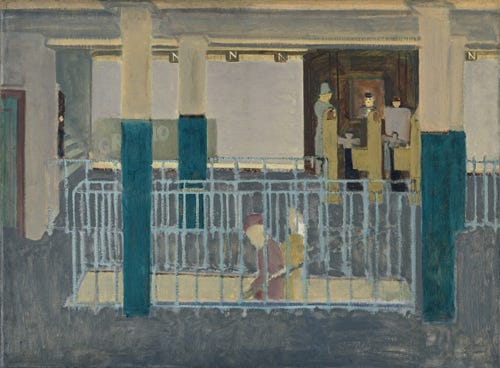
Image above is Mark Rothko. I don’t have a lot of recommendations this week but I found this article by Gideon Lewis-Kraus to be incisive and alarming. I found the Biennial to be mostly underwhelming except for a few really wonderful artists. It is, after all, a networking event.
Recent writing:
Review of Alpha for Screen Slate.
related to your Gavin Newsom piece - funny enough, there was a rumor at one point that Amy Sherman-Palladino was just a pseudonym for Aaron Sorkin considering their similar mania for talky dialogue